
Every Minute Counts: The Real Math Behind Shipping's Missing Profit
Fuel, demurrage, market timing, and voyage drift — the real arithmetic behind shipping's missing profit.
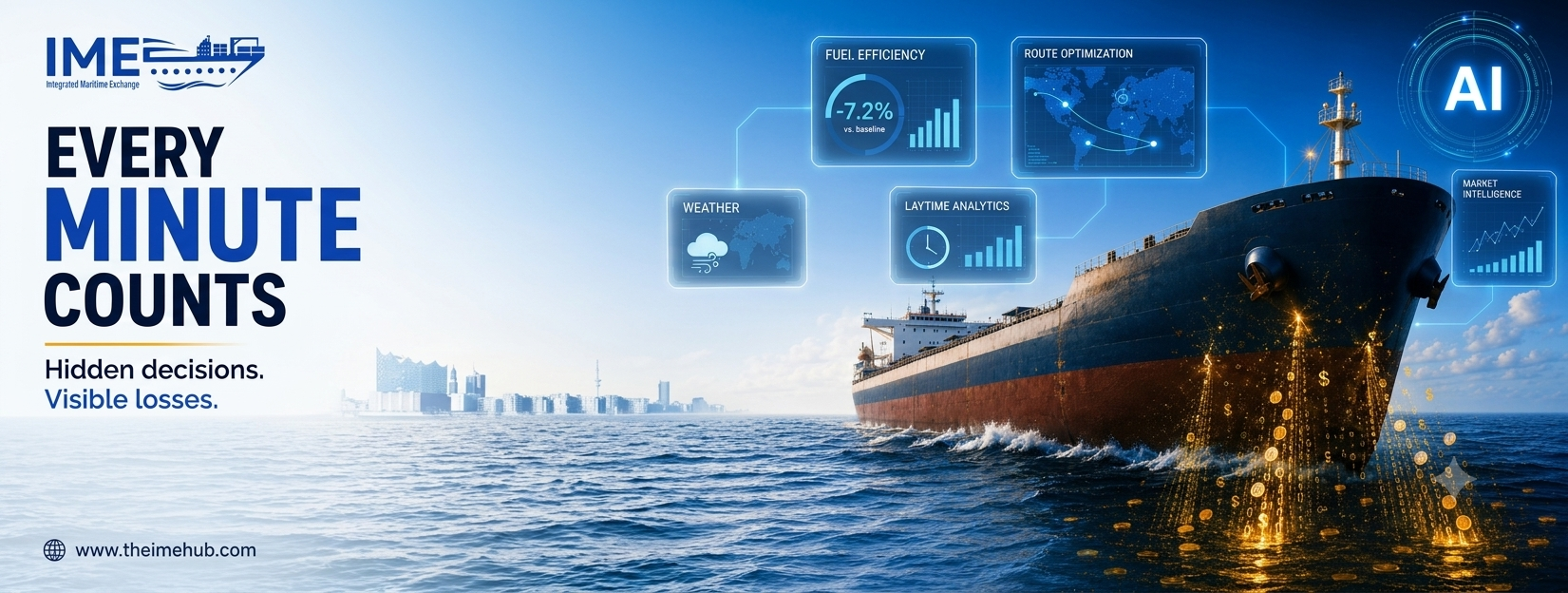
Table of Contents
A note for owners, operators, and the young officers who will run tomorrow's desks.
Here's a question I like to open with: when a vessel is losing money, where exactly is it leaking out?
Ask a room of freshly minted operators and you'll get the same chorus every time: bunkers, port dues, canal transit, agency fees. All correct. But look closer, almost every one of those "costs" is actually a decision wearing a disguise. That bunker bill? It's the shadow of a routing choice made days earlier. That demurrage claim? It's the shadow of a laytime clause someone skimmed too quickly.
Cost, in this trade, is rarely an accident. It's the arithmetic of decisions made long before the vessel ever slips her lines.
So let's do what good seamanship demands: look at the arithmetic honestly, one leak at a time.
1. Fuel: Where Good Routing Pays You Back in Silence
Fuel is the single biggest line on any voyage account and it's also the most responsive to intelligence applied early, before the engines are even turning over.
Start with the floor. The IMO's own numbers show that even basic weather routing shaves off at least 3% of fuel burn. That's the conservative case the "we barely tried" number.
Now raise the bar. Bring in genuinely adaptive, AI-assisted optimization, and the range widens fast:
- 3–10% per voyage, according to independent maritime software analysis of optimized routing and speed adjustment.
- 5–12% fleet-wide, per one machine-learning fuel platform's own data.
- ~$100,000 per vessel, per year — a 3–5% cut, measured across 267 vessels running an AI navigation system that simply reduced extreme manoeuvres and tightened routing.
- 5–7% across an entire fleet, reported by a shipping company that's been running an AI fuel system since 2019.
Put a percentage next to a number like $100,000 and suddenly it isn't abstract anymore. It's real money that either stays on your P&L or doesn't.
And notice: none of these gains come from "steaming harder." They come from deciding better recalculating the smartest speed and heading as weather, currents, and arrival windows shift, again and again. That's the entire discipline of good voyage estimation: knowing what the sea is likely to charge you before you commit to a route, and picking the one that charges least. A tool like Navitron exists to put exactly that discipline at an operator's fingertips the estimate you trust before the fixture, not the regret you tally after it.
2. Demurrage: The Cost of a Document Read Carelessly
If fuel is where money leaks quietly, laytime is where it hemorrhages in disputes.
Consider the scale. In dry bulk alone, demurrage is estimated to move roughly $8–10 billion a year the market-standard 6–8% applied against north of $125 billion in annual freight spend. That's not a rounding error. That's a river of cash flowing between owners and charterers, and which way it flows often comes down to a single calculation.
And that calculation is shockingly fragile. Consider this: on a vessel with a $20,000/day demurrage rate, mis-logging a weather event by just six hours swings the claim by $5,000. Not six days. Six hours. One misread line in a Statement of Facts.
Another practitioner's version of the same lesson: a weather stoppage logged as four hours instead of six, or a cargo resumption time off by half an hour, can shift thousands of dollars between demurrage and despatch in either direction.
I've sat on both sides of these arguments, as a Master and as a maritime lawyer, and I can tell you exactly where they're won and lost: in the reading of the SOF and the precision of the timesheet. Getting excluded periods right is, by far, where manual laytime calculations most commonly fall apart. The clause was always there. The event was always logged. The money was lost because a tired human was doing careful arithmetic under time pressure which is exactly the kind of task we should stop asking humans to do unaided.
That's the quiet case for a purpose-built laytime engine. When Layspan parses the Statement of Facts, applies the charter-party terms consistently, and produces a defensible timesheet, it isn't replacing the operator's judgment. It's protecting that judgment from the one thing it can't survive: fatigue and volume. Every hour classified correctly is a claim you can actually stand behind.
3. You Can't Price a Voyage in a Market You Can't See
Old brokers knew this in their bones: the freight number you accept is only as good as your read of the market on the day you accepted it.
Rates move. Bunker prices move. Regional imbalances open and close within a week. An operator working off last month's mental picture is, functionally, quoting blind.
The answer isn't to abandon instinct it's to arm it. Current, structured market intelligence where tonnage is tight, where it's long, what comparable fixtures actually cleared at should be bending every offer you make. That's the role a market analytics layer like MarkX is built to play: turning the scatter of market noise into a view you can actually price against. The seaman's instinct still makes the call. It just makes it with its eyes open.
4. The Estimate Has to Survive Contact With the Real Voyage
Here's where too many good plans quietly unravel. The estimate looks elegant on paper. The fixture gets signed. Then the voyage actually happens and nobody's watching whether reality is tracking the plan until the accounts close, long after anything can be done about it.
A voyage is a living thing. Ports slip. Weather turns. An arrival window that looked comfortable on Monday is razor-tight by Thursday. The operators who protect margin are the ones who catch the drift while it's still correctable who treat voyage operations as an ongoing conversation between the plan and the sea, not a document filed and forgotten. A tool like Seal exists to keep that conversation live: estimate, execution, and variance in one view, so the correction happens at sea, not in the post-mortem.
The Leaks, By the Numbers
The numbers here aren't marketing copy they're the industry measuring its own leaks:
| Leak | Documented Cost |
|---|---|
| Basic weather routing (unoptimized) | ~3% fuel saved, at minimum |
| Serious AI-driven optimization | 5–12% fuel saved |
| Fleet-scale AI navigation (267 vessels) | ~$100,000/vessel/year |
| Dry bulk demurrage, industry-wide | $8–10 billion/year |
| Single 6-hour SOF misread | $5,000 swing on one claim |
Bringing It Together on the Bridge
So back to where we started. Where does a vessel actually lose money?
In the gap. The gap between the decision that could have been made with good information, and the decision that actually got made without it. Fuel lost to a route chosen on assumption. Demurrage lost to a clause read in haste. Margin lost to a market misjudged and a voyage nobody was watching.
The lesson underneath every one of these numbers is a lesson seamanship has always taught: prepare early, measure honestly, and never let time drift past you unaccounted for.
The tools change AI is just the newest hand on deck. But the principle is as old as the trade itself: in shipping, every minute counts, and the money follows the minutes.
Watch your minutes. The rest follows.
Explore the IME Suite
See all 9 AI tools built to close the small gaps that add up to missing margin.
Explore the IME Suite → AI & Technology
Navigating the Digital Seas: Transforming Commercial Shipping Through Technology
 Cargo Fixing
Navigating the Seas of Business: Challenges & Solutions in Fixing Cargo for Vessels
Profit & Operations
Every Minute Counts: The Real Math Behind Shipping's Missing Profit
Subscribe to the IME Newsletter
You'll receive exclusive updates on advancements to the IME Platform.